Leadership Assessments Allow Us to Hire and Develop Leaders with Clarity

Updated: Feb 20
Editor's Note: This article was co-authored with a Bridg Staffing Team member.
How are you identifying excellent pastors and organizational leaders? How are you hiring them and developing them once they join your team? What process are you using? What tools are you relying on? And most importantly, are they working?
How Are You Identifying and Developing Leaders?
Your leaders play a crucial role within your church, business, or organization. They are entrusted with guiding your most valuable resource, your people. Are they being encouraged in the God-given areas that truly motivate and energize them? Do they feel genuinely supported and cared for?
Is fuel proactively being poured into their tanks, or is it slowly being depleted? Are you preparing a pathway for their growth and development or leaving them to navigate the abrasive speed of change in today’s climate alone?
The way you develop and lead your people will significantly determine your overall success in fulfilling your God-given vision.
Quick Alignment Check
Ask yourself these three questions:
Hiring: Are you hiring in a way that aligns new team members’ motivations and wiring with the role you need them to fulfill and with your existing team culture?
Developing: Are you intentionally investing in your team members’ development, both formally and informally?
Succession Planning: Are you identifying future leaders and intentionally pouring into their lives as next-generation leaders?
The answers to these questions will directly influence the motivation of your leaders and the long-term health and effectiveness of your church, business, or organization.
Invest in Your Leaders with a Personal Assessment
Faithful leadership stewardship begins with intentional investment in the people God has entrusted to you.
When leaders are understood, affirmed, and developed according to how God has uniquely wired them, their capacity and effectiveness are unlocked. This kind of investment produces exponential impact not only within the organization, but across congregants, staff, volunteers, vendors, and the broader community.
One of the most powerful ways to inspire leaders is to understand what truly drives, motivates, and discourages them. Personal assessments provide that.
Creating shared expectations for growth and equipping leaders with practical tools to pursue that growth mobilizes each person to contribute meaningfully within their unique role, whether in a church, for-profit business, or nonprofit organization.
When leaders are consistently reconnected to the mission, vision, and values of the organization and encouraged to lead from their God-given design, their potential is unleashed. This kind of discovery and encouragement adds fuel to a leader’s calling, igniting momentum that compounds over time.
As leaders, we reap what we sow. When we invest sparingly in leadership development, we reap sparingly. But when we sow generously into the growth and future of our people , especially our key current and emerging leaders, the return is significant.
Healthy organizations are built by healthy leaders, and healthy leaders cultivate healthy cultures through aligned hiring and intentional leadership development. Personal assessment tools (IKMD, DISC, Birkman, PI , or Myers-Briggs) make that process easier.

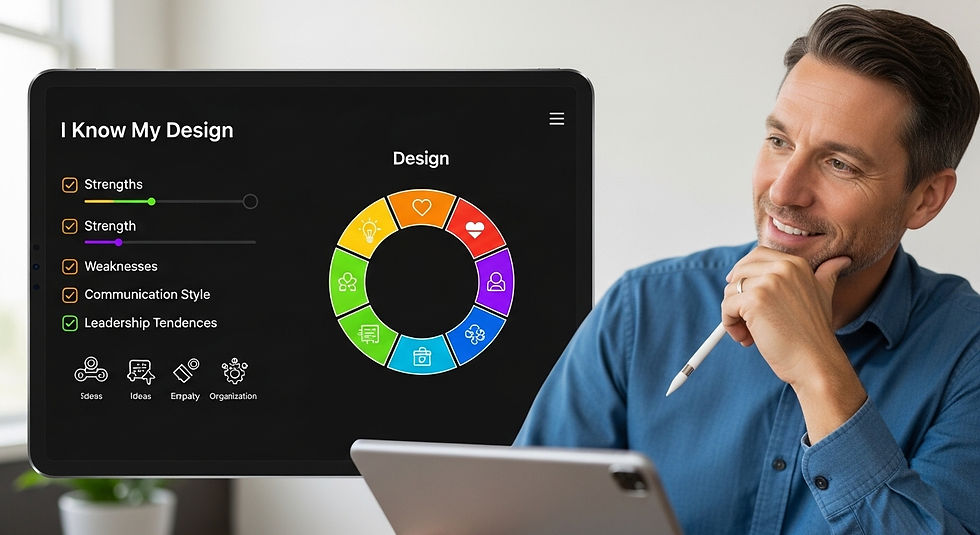
Personal Assessment Tool: I Know My Design (IKMD)
Ensuring your culture is healthy and aligned with your theology, mission, vision, and values provides the fuel and inspiration necessary to accomplish great and even audacious goals you may not have thought possible.
One powerful tool that continues to serve churches and faith-based organizations well is the use of a personal or leadership assessment to identify what truly motivates and demotivates you and your teams.
These assessments allow you to understand your leaders and teams at a deeper level. They are designed to uncover the underlying drivers, motivators, and discouragement patterns of pastors, organizational leaders, and staff. The insights gained from this process can be transformative.
Often, the assessment reveals dynamics that may otherwise remain hidden or unspoken. Generally speaking, people tell leaders what they believe leaders want to hear and do what they believe is expected of them. This may or may not align with how they are actually wired and motivated.
This is especially true in the hiring process. When someone desires to join your organization, they will naturally present themselves as the right fit. But what if the core responsibilities of the role do not align with how they are truly wired?
How much unnecessary strain, misalignment, and unintended consequence could be avoided with greater clarity on the front end? We can facilitate this assessment process for your leaders and teams, helping you hire and develop with confidence.
We appreciate a variety of assessments (MBTI, Birkman, DiSC, Enneagram, or PI) that exist, because they each have their merits, but we like to use I Know My Design (IKMD), which is an enhanced DISC-based personal assessment tool, because of its easy-to-read report and faith-based organizational background.
The Extreme Cost of Mis-Hires
How long does it typically take to determine whether you have made a strong hire or a costly mistake? In our experience, approximately 90 days.
In hiring and onboarding, we often refer to this as the “90-day rule”: the true alignment of the individual and the role becomes evident within the first three months. When the role does not match how someone is wired and motivated, the result may be turnover.
A mis-hire carries both hard and soft costs. Financially, the cost can range from 20–30% of an employee’s annual wages when factoring in recruiting, onboarding, and lost productivity. However, the cultural impact, especially in senior-level roles, is often incalculable.
High turnover negatively impacts your budget and creates additional soft costs that are not always measured, including:
Soft Costs: Increased stress on remaining team members, diminished morale, reduced efficiency, and leadership distraction. When someone leaves, others must absorb unfinished responsibilities while maintaining their own workload.
Consistent turnover is often a symptom of deeper cultural or leadership issues that need to be discovered and addressed. Having the courage to investigate and take necessary action is part of faithful shepherding and responsible organizational oversight.
These same discovery principles apply not only to new hires but also to your current leaders and team members.
The Value of the Assessment
A well-designed assessment provides meaningful insight into what motivates and inspires pastors, organizational leaders, and staff. This discovery process equips leaders to draw out the best in those around them and to communicate and act more effectively as a team pursuing a shared vision.
Taking an “under-the-hood” look at what truly drives your leaders provides invaluable clarity for cultivating healthy, aligned leadership.
Assessment tools add significant value in:
Executive Searches
Specialized Searches
Search Team Advising
Succession Planning
Leadership Coaching
Leadership Development
Evaluating Current Leadership Fit
When these insights are thoughtfully applied, they add fuel to the tanks of your leaders, maximizing both individual and collective impact within your organization and in the broader marketplace and community.
Building up the body of Christ is central to our mission as Christian leaders. If you are ready to hire and develop with greater clarity, we would be honored to serve you so that you can be strengthened to bless others.


Comments